Writing
Writing is a magical medium. It’s a vehicle for communication, connection and creativity. At Benton Dene School we view writing is an integral part of every child’s education.
Handwriting
Dough Disco and Squiggle while you Wiggle
Our pre-writers have daily opportunities to utilise and develop their fine motor skills in many purposeful ways. However, they will also be taking part in interventions such as Dough Disco and Squiggle while you Wiggle.
Squiggle while you wiggle is an early writing program created by Shonette Bason-Wood, who also created the program Playdough Disco. Squiggle Whilst You Wiggle incorporates dance, music and large movements to help children develop the fine muscle control they need for writing. They will learn a new gross motor movement to a piece of music while holding 'flappers' (bits of fabric) while dancing along to the music. The children then transfer these movements to floor level and swap their flappers for writing tools (crayons/pens etc) to make marks, this could be in foam, on paper, in sand etc. They will then use this action to think of letters they can form that use this shape. These sessions are great fun but most importantly help your child to be confident mark makers.
Here is a video of Shonette and the Spread the Happiness Crew demonstrating the first three moves in the Squiggle Whilst You Wiggle teaching method for writing.
- Movement 1 - up and down

Dough Disco
This helps to strengthen children's fine motor muscles to enable them to develop their pencil grip which in turn will help to develop their writing skills. But most of all it's fun! Put any music on, get some dough and follow the movements below!


Handwriting Without Tears
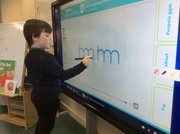
Across school when our children find handwriting tricky we use an intervention called Handwriting without Tears. We help children develop their writing skills through multisensory, play-based instruction. Children move, touch, feel and manipulate real objects as they learn essential skills for writing.
We use music to speak to children and promote movement and memory. Our multisensory lessons use voices, letter stories, air writing, tracing and letter games to teach letter formation and placement on lines
If you want to know about Handwriting Without Tears, take a look at our training slides.

- Wet Dry Try
- Using woods
- Using woods
- Try
- Good progress James!
- Ready to move on


Penpals for Writing
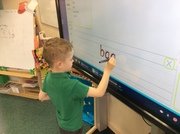
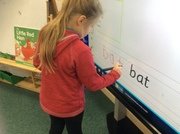
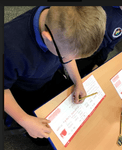
When our children develop fine motor control we move onto Penpals for Handwriting.
Penpals for Handwriting is a complete handwriting scheme for 3–11 year olds that offers clear progression through five developmental stages: physical preparation for handwriting; securing correct letter formation; beginning to join along, securing the joins and practicing speed, fluency and developing a personal style. Penpals is focused on whole-class teaching using digital resources to enable modelling and interactive learning, along with Practice Books and Workbooks to support independent work. The Foundation content is in line with the EYFS Framework/Pre Key Stage Standards and the Year 1–6 content supports frequent, discrete and direct teaching of handwriting for 5–11 year olds, as required by National Curriculum 2014.
- Following letter pattern
- Tracing between lines
- Writing words independently
- Adding joins
Colourful Semantics
Within school we recognise that some of our pupils will need symbol support to construct sentences. We therefore use ‘colourful semantics’ to support our pupils, across the curriculum, to show their knowledge and understanding of their learning.
Colourful Semantics is a language-based intervention designed to support children in developing their spoken and written language skills. It focuses on helping children understand and construct sentence structure by using a colour-coded system. Each colour represents a different part of a sentence, including subject, verb, object, and location. This visual approach helps children break down sentences and understand the role of each word.
The intervention assigns colours to specific sentence components:
- Who (subject)
- What doing (verb)
- What (object)
- Where (location)
Children begin by constructing simple sentences using visual prompts and gradually build more complex structures as their confidence and understanding grow. For example:
- Start with: The boy is kicking (who + what doing)
- Then add: The boy is kicking a ball (who + what doing + what)
- Later: The boy is kicking a ball in the park (who + what doing + what + where)
Benefits include:
- Improved understanding of sentence structure
- Enhanced expressive and receptive language skills
- Increased vocabulary
- Support for both spoken and written communication
- A structured, visual, and engaging learning method
Talk4Writing
At Benton Dene School we use our own modified version of 'Talk4Writing' following Pie Corbett's Talk4writing principles.
Our aim is to explore the use of storytelling as a tool to help our children build a bank of narrative patterns they can use when creating their own stories.
Our 'Talk4Writing'involves
- the learning of key vocabulary
- the learning and repeating of repetitive phrases and oral stories
- building children's confidence in storytelling through drama
- extending storytelling into writing
This results in new stories being prepared and rehearsed prior to writing.
Reading is at the heart of our English curriculum and therefor we offer a range of quality texts that cover various genres, authors, poetry and nonfiction to support developing writing across school.
If you want to know more about our adapted version of T4W click on the document below
Early sentence structure is dependent on having an understanding of key vocabulary. In Benton Dene School we use the Colourful Semantics Programme to support sentence building progression using symbols. This method is used in our T4W when children are working in our Early Years or Pre Key Stage Standards.
If you would like to know more about how we use colourful semantics to support our curriculum please see the slides below.